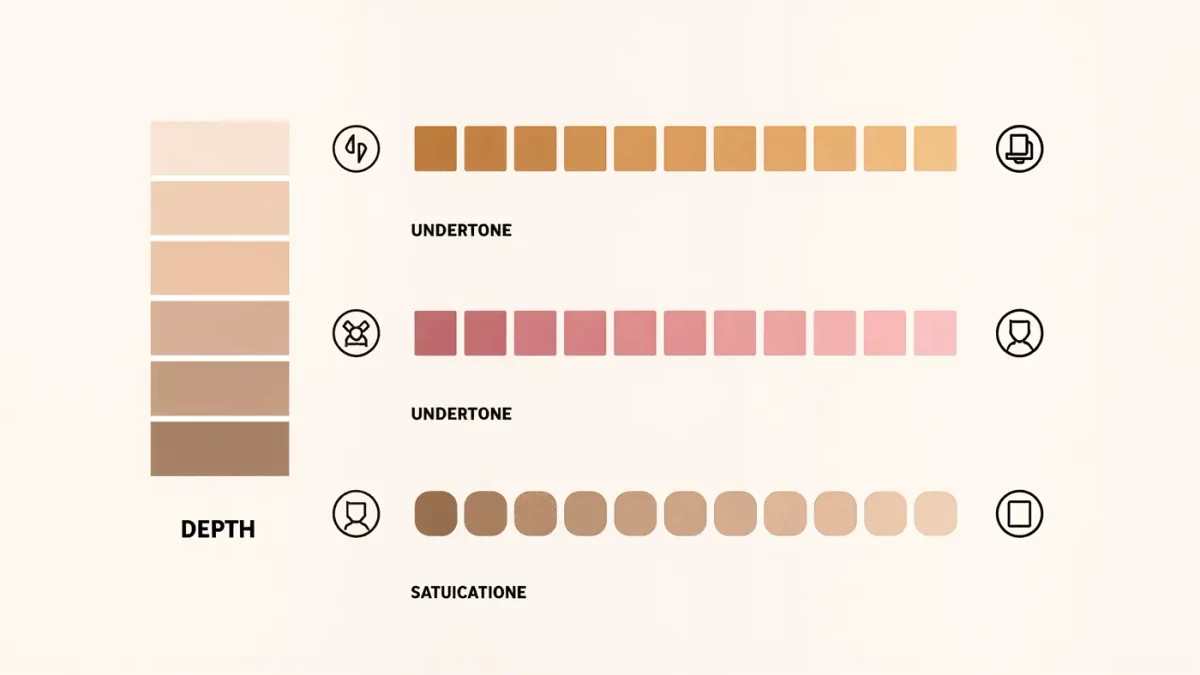
To choose your foundation shade, swatch three candidates on your jawline in daylight and buy the one that becomes invisible after it dries. That is the entire method, and it beats any quiz or camera app: your jaw shows how the base meets your neck, which is the only seam other people actually see. Shade ranges commonly run 30 to 60 options per brand, which sounds overwhelming until you narrow them with the three-dimension system below.
One note before the method: foundation advice here is cosmetic guidance, not medical advice. If you have an active skin condition or a known allergy, check ingredient lists against your sensitivities and consult a professional when unsure.
What are the three dimensions of a shade?
Every foundation shade is a combination of depth, undertone, and saturation. Get all three roughly right and the shade disappears; miss one and the base looks like a mask.
- Depth is how light or dark the shade is. This is the easiest dimension: compare the swatch to your bare skin and you will spot a mismatch immediately.
- Undertone is the temperature under your skin's surface: warm (yellow, golden, peach), cool (pink, red, blue), or neutral (a balance of both). Undertone mismatches are why a depth-matched shade can still look gray or orange.
- Saturation is how much pigment the shade carries. Highly saturated complexions need saturated shades even at the same depth, or the base looks chalky.
How do you identify your undertone?
Three quick checks work better than any single test. Look at the veins on your inner wrist in daylight: green-leaning suggests warm, blue or purple suggests cool, and hard-to-call suggests neutral. Then check how your skin behaves in the sun without burning: tanning easily points warm, burning first points cool. Finally, hold a plain white sheet of paper next to your bare face; if your skin looks golden next to it you are likely warm, pink likely cool. If the three checks disagree, pick neutral and let the jawline swatch make the final call.
Which light should you test in?
Daylight, near a window, at midday. Store lighting distorts color: many department store mirrors run warm, and some drugstore aisles run harshly cool, so a shade that vanishes under the counter lights can look wrong outside. Test near a window with the product fully dried down, because most foundations oxidize slightly as they set and read a touch deeper after five minutes. Check the swatch again outdoors before you commit.
The three-swatch method, step by step
- Narrow by depth first. Using the brand's shade finder or the tester row, set aside three shades close to your depth: your best guess, one lighter, one darker.
- Filter by undertone. Discard any of the three whose undertone is clearly wrong, and pull the neighboring shade in the right undertone family to replace it.
- Swatch on the jawline. Draw a short stripe of each candidate down the side of your jaw, about a finger-width apart. Do not swatch on your hand or wrist; hand skin differs from face skin in depth and undertone.
- Wait five minutes. Let each stripe dry completely, then blend it lightly with a fingertip.
- Choose the one you cannot find. Step back, look in daylight, and buy the stripe that has disappeared. If two disappear, pick the one closer to your neck.
Related stories: How to Contour Subtly: Shadow, Not Stripes · How to Make Makeup Last All Day: Seven Steps From Skin Prep to Setting.
What if you fall between two shades?
Two workable options exist. The simpler one: buy the shade that matches your neck and accept a slight difference from the face. The precise one: buy two shades and mix them, one matched to your face and one to your neck, which is exactly what professional artists do for clients whose face and neck differ. Seasonal changes matter too; many people run one to two shades deeper in summer, so note your summer shade when you find it.
Do formulas change the shade you need?
Yes, slightly. Sheer tints read lighter on the skin than full-coverage foundations of the same labeled shade, because coverage determines how much pigment sits on the surface. A matte finish can also read a touch deeper than a dewy one since it reflects less light. When you switch formula families, retest with swatches instead of assuming the same shade code carries over.
| Sign in the mirror | Likely problem | Fix |
|---|---|---|
| Base looks gray | Undertone too cool for your skin | Move toward a warm or golden shade |
| Base looks orange | Undertone too warm, or depth too dark | Try a neutral shade, or one step lighter |
| Base looks pink on your neck | Undertone too cool and shallow match | Match to the neck in a neutral tone |
| Face and neck look different | Depth matched to the face only | Mix two shades or blend down the neck |
Which mistakes cost people money?
- Buying online without checking the brand's shade finder against a shade you already own. Most finders let you enter your current brand and shade, which anchors the search in real data.
- Trusting one store visit. Lighting varies, so a daylight re-check protects the purchase.
- Skipping the dry-down. The five-minute test catches oxidation before you wear it for a day.
FAQ
Should foundation match my face or my neck?
Your neck. The seam between face and neck is the most visible edge of your makeup, so the neck is the anchor. If your face is noticeably darker from sun exposure, match the neck and add warmth to the face with bronzer rather than with base.
Can a photo or app match my shade for me?
Apps are useful for narrowing depth but unreliable for undertone, because phone cameras shift color. Use an app to shortlist three candidates, then confirm with jawline swatches in daylight.
Do I need a different shade for winter?
Often, yes. Skin commonly runs lighter in winter, so keep two depths if your climate has real seasons. Blending a lighter and darker shade across the year covers most people's range.
What is oxidation, and does it affect every foundation?
Oxidation is a slight deepening or shift in tone as the formula interacts with air and skin oils during the day. Some formulas shift more than others, which is why the dried five-minute swatch matters more than the fresh stripe.