To contour subtly, use a matte shade one to two steps cooler and deeper than your skin, apply it only under the cheekbones, along the hairline, and lightly on the jaw, and blend until you can no longer find where it starts. Contour that reads as makeup is almost always a shade problem or an under-blending problem, not a placement problem. Modern contour products are color cosmetics regulated like any other by the FDA, so this is purely a technique question (FDA, 2026).
BEAUTYISE publishes information, not medical advice. Skip contouring entirely on irritated or broken skin and let it recover first.
What shade should a subtle contour be?
The rule is cooler and deeper, not warmer and darker. Real shadow is grayish: it has the warmth drained out of it. A bronzer, which is warm by design, adds sun; a contour shade should imitate the way a cloud passes over your face. Pick a matte product one to two steps deeper than your skin tone with a gray or taupe base, and avoid anything with shimmer or strong orange undertone. If the only options available run warm, the lightest hand and heavy blending compensate; nothing else does.
Where do the three zones sit?
- Under the cheekbones. Suck in your cheeks and feel the hollow. Place the product in the hollow itself, starting from the ear and stopping about two fingers' width from the mouth, because contour that travels too far forward drags the face down.
- Along the hairline. A thin wash at the top of the forehead narrows the visual width of the face and ties the contour to the rest of the head. Skip it if your hair is always pulled back and the forehead is on display; there it needs the lightest touch.
- Along the jaw. A soft line under the jawbone, blended downward into the neck shadow, defines the lower edge of the face. This is the zone beginners skip and the one that does the most quiet work in photos.
Optional additions depend on your face: a tap down the sides of the nose narrows it, and a light line under the chin extends the jaw work. Both are refinements; learn the three main zones first.
How do you blend so it disappears?
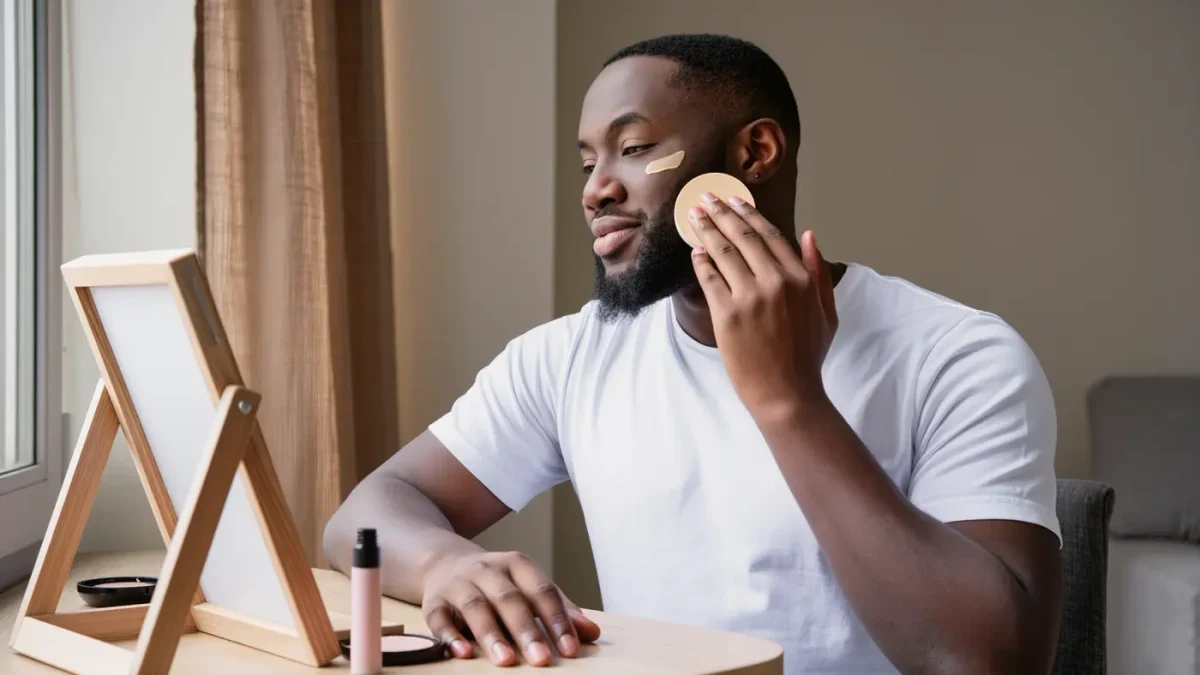
Budget two to three times longer for blending than for application. A cream contour applied in thirty seconds wants about two minutes of blending; anything less leaves an edge that daylight finds immediately. Use a dense sponge or a fluffy synthetic brush, work in small bouncing motions from the edge of the product inward, and check from arm's length in natural light, where stripes announce themselves. The finished test: you should not be able to say where the contour begins, only that the cheekbone looks higher.
Cream or powder contour?
Cream suits dry and normal skin and goes over a liquid base before powder; it stays movable longer, which helps beginners. Powder suits oily skin and goes on after the base has set; it is harder to overdo because each layer is thinner. The order rule from blush applies here too: do not press powder products into wet cream, or both patch. If your routine is powder-forward, learn powder contour; the two formulas solve the same puzzle at different moments.
How much product is one application?
For cream, less than a pea per cheek, dabbed and stretched by the sponge. For powder, one light tap of the brush per side, tapped off before it touches the face. Contour is the least forgiving product to build back down: removing half a stripe usually costs you your base as well. Two thin layers of contour look like structure; one thick layer looks like dirt on the face.
| Result in the mirror | What went wrong | Fix |
|---|---|---|
| Brown stripes on the cheeks | Warm shade or under-blended | Switch to a taupe shade, double the blending time |
| Muddy, gray patches | Shade too deep | Go one step lighter, keep the cool tone |
| Face looks dirty by afternoon | Cream contour over unset base | Set the base first, or switch to powder contour |
| Contour invisible entirely | Too light or over-blended away | Add a second thin layer rather than one heavy pass |
When should you skip contouring?
On bright summer days with no photograph at the end of them, when blush and bronzer carry the face more naturally. On days your base is minimal, since contour needs a smooth canvas and reads heavy over bare skin. And for anyone who dislikes the maintenance: subtle contour is invisible at conversation distance, which means it is also the first thing to skip when time is short.
FAQ
Is contouring suitable for beginners?
The subtle version yes, because the mistakes are small and fixable. Start with only the cheekbone zone, in cream, on a weekend, and add the hairline and jaw once the first zone blends without stripes. One zone at a time keeps the learning curve gentle.
Can I use bronzer as contour?
It adds warmth rather than shadow, so it reads as sun rather than structure. On very warm skin tones a matte bronzer can double as contour because the undertones align. For most people, one cool matte contour shade is the better single purchase.
Does contour change with lighting?
Strongly. Hard indoor lighting and camera flash exaggerate edges; daylight is the most honest reviewer. Always finish the check near a window, because a contour blended under warm bathroom bulbs can look striped the moment you step outside.
How is contour different from bronzer?
Contour imitates shadow: cool-toned, matte, placed in hollows. Bronzer imitates sun: warm-toned, placed where light hits, on the high points and across the bridge of the nose. The two can coexist in one look, contour for structure and bronzer for warmth, in that order.