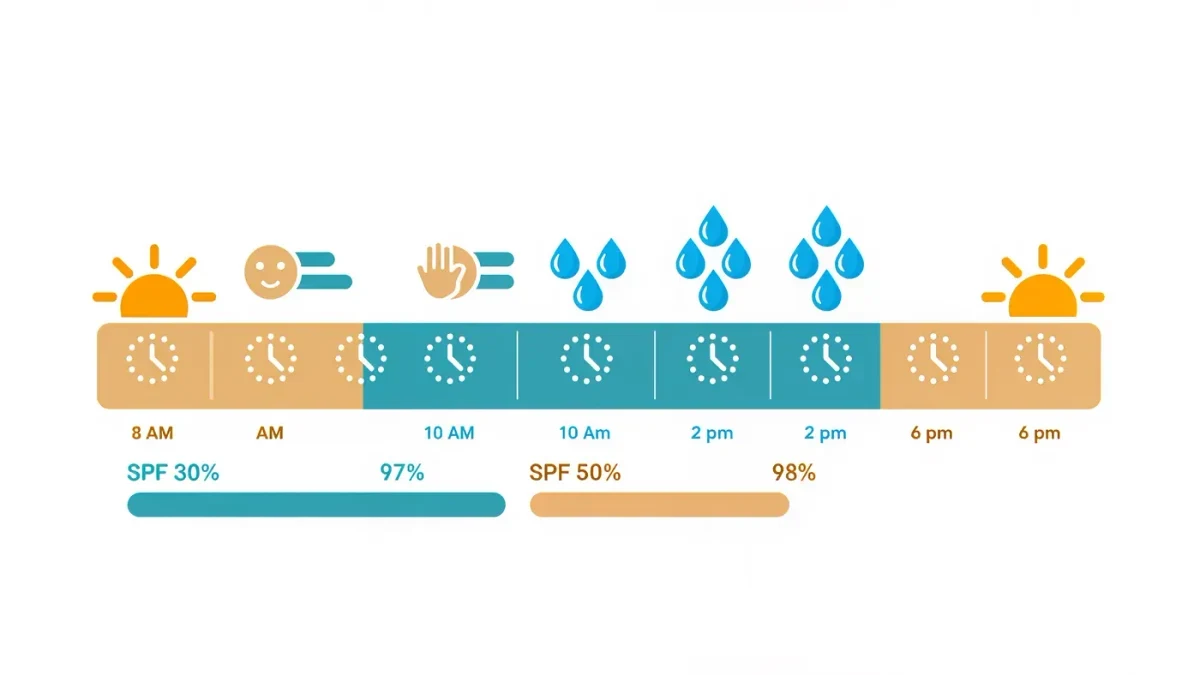
Wearing sunscreen every day takes three habits: apply a broad-spectrum SPF 30 or higher as the last step of your morning routine, use enough, about two finger-lengths for face and neck, and reapply every two hours when you are outdoors. The American Academy of Dermatology and the FDA both anchor daily protection to SPF 30, broad-spectrum labeling, and water resistance for outdoor days, because ultraviolet exposure accumulates even on cloudy and cold days.
Anyone with a history of skin cancer or a changing mole should follow the screening and monitoring plan set by their dermatologist.
Why bother with SPF on days you stay inside?
UVA rays, the ones that age skin, pass through window glass, and incidental exposure adds up across a lifetime of commutes, lunches outside, and desk seats near windows. Dermatology guidance treats daily sunscreen as the single most evidence-backed anti-aging step available, and the Skin Cancer Foundation notes that regular daily use of SPF 15 or higher reduces the risk of developing squamous cell carcinoma and slows visible aging in trials of daily versus discretionary use. The point of daily wear is that you never have to guess how much UV the day will bring.
How much sunscreen is enough?
Laboratories rate a sunscreen's SPF assuming two milligrams of product per square centimeter of skin. Most people apply a quarter to half of that, which can cut real-world protection dramatically. Two practical measures close the gap:
- The two-finger rule for the face and neck: squeeze a line of sunscreen along the full length of your index and middle fingers and apply all of it.
- The FDA's measure for the body: about one ounce, a shot-glass worth, to cover exposed skin in a swimsuit.
If a two-finger dose feels like far too much product, the fix is a lighter texture, not a smaller dose.
When should you apply it, and how often reapply?
Apply sunscreen as the final step of your morning routine, after moisturizer, so it forms an even top layer. Give it a few minutes before makeup. The standard reapplication guidance from the American Academy of Dermatology is every two hours outdoors, and again after swimming or heavy sweating even on water-resistant formulas, because water resistance is rated for either 40 or 80 minutes. Indoors with no window exposure, a single thorough morning application is generally reasonable until you go out.
| Situation | Morning dose | Reapply? |
|---|---|---|
| Desk day, brief commutes | Two fingers, face and neck | If sun exposure grows |
| Outdoor errands, walk lunch | Two fingers, plus ears and hands | Every 2 hours outside |
| Beach, hike, sport | One ounce for the body | Every 2 hours, after swimming or sweating |
| Snow or high altitude | Full dose, lip balm SPF | Every 2 hours, snow reflects UV |
Chemical or mineral: does it matter?
Both types protect when used correctly. Chemical filters, such as avobenzone and oxybenzone, absorb UV and convert it to heat; mineral filters, zinc oxide and titanium dioxide, sit on the surface and scatter and absorb it. Mineral formulas are often better tolerated by sensitive and reactive skin, while chemical formulas tend to leave less of a white cast on deeper skin tones. The FDA has asked for additional data on several chemical filters while affirming that the benefits of sunscreen outweigh the risks when used as directed, which is why the practical advice is to choose the formula you will actually reapply.
How do you make daily SPF feel effortless?
Attach it to something you already do: brush your teeth, then sunscreen. Keep the tube beside your keys or your coffee machine so it is physically in the path of leaving the house. Pick a texture you like, gel-cream for oily skin, cream for dry skin, and consider a tinted mineral formula if the white cast bothered you before. For ears, eyelids, and the back of the hands, the exposed areas people forget most, a stick applicator makes coverage fast and precise.
What about sunscreen in makeup or moisturizer?
A moisturizer or foundation with SPF is better than nothing, but makeup is rarely applied thickly enough to reach the labeled protection, a point the FDA makes in consumer guidance. Treat cosmetic SPF as a bonus layer over a real dose of sunscreen, not a substitute, especially in months when you spend meaningful time outdoors.
The best sunscreen is the one you apply generously and reapply without resentment.
FAQ
Do I need sunscreen on cloudy days?
Yes. Up to 80 percent of UV rays pass through cloud cover, according to the Skin Cancer Foundation, so overcast days still deliver meaningful exposure, particularly UVA.
Is SPF 30 enough, or should I use SPF 100?
SPF 30 blocks about 97 percent of UVB when applied properly, and SPF 50 blocks about 98 percent. Application thickness matters more than the number on the bottle, so a well-applied SPF 30 beats a thin layer of anything higher.
Can dark skin tones skip sunscreen?
No. Melanin provides partial natural protection, but people with deeper skin tones still develop photoaging, pigmentation conditions such as melasma, and skin cancers, which are often detected later. Daily SPF 30 remains the recommendation.
Does sunscreen block vitamin D production?
Real-world studies show sunscreen use does not commonly cause vitamin D deficiency, partly because no one applies perfectly. If you have concerns about vitamin D levels, discuss testing and supplementation with your clinician rather than skipping SPF.