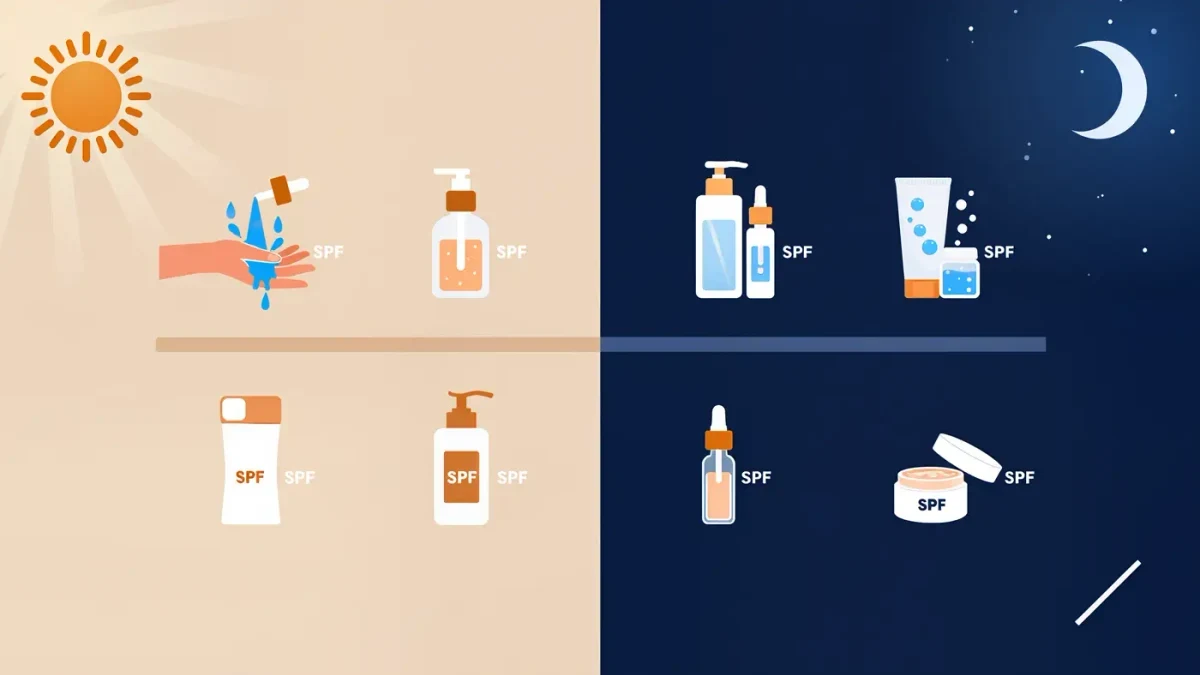
Morning and evening skincare differ in purpose: the morning routine protects skin against the day, UV, pollution, and water loss, while the evening routine cleans away the day and supports overnight repair. In practice that means three changes between the two: sunscreen appears only in the morning, cleansing is thorough only at night, and the strongest actives usually move to the evening because several of them, retinoids in particular, degrade in sunlight and increase sun sensitivity.
Prescription skin treatments should always follow the schedule your prescribing clinician gave you, which can differ from the general patterns described here.
What does your skin actually do overnight?
Skin runs its housekeeping while you sleep: studies of circadian rhythms in skin describe higher overnight blood flow, increased water loss through the surface, and peak cell repair processes in the late evening and night. Water loss peaks during the night, which is one reason evening moisturizers can be richer than morning ones without feeling heavy. It also explains why skin can look slightly puffy and hydrated in the morning, then tighter by midday. Your routine works best when it supports these two different phases instead of running the same script twice.
What belongs in the morning, and why?
The morning has one priority: defense against what the day brings. The classic sequence takes under ten minutes:
- Rinse or light cleanse. Water or a gentle cleanser removes night sweat and leftover product without stripping.
- Antioxidant serum, optional. Vitamin C is the conventional morning choice because antioxidants are used alongside sunscreen against free-radical damage from UV and pollution.
- Moisturizer. Lighter textures in the morning, since daytime heat, makeup, and sunscreen layer on top.
- Sunscreen, always last. SPF 30 or higher, broad spectrum. This is the single step that makes the morning routine different from the evening one, and dermatology consensus treats it as the most evidence-backed anti-aging step in skincare.
What belongs in the evening, and why?
The evening has two priorities: removing the day and supporting repair. The sequence mirrors the morning in shape but not in content:
- Thorough cleanse. This is the day's real wash: sunscreen, sebum, pollution particles, and makeup all come off here. If you wore makeup and heavy sunscreen, a two-step cleanse, cleansing oil or balm first, gentle cleanser second, removes both layers cleanly.
- Treatment actives. Retinoids are the textbook evening active, because they break down in sunlight and increase sensitivity to UV, so nighttime application gives them the stable, dark window they prefer. Exfoliating acids also sit most comfortably in the evening for the same sensitivity reason.
- Richer moisturizer. Since water loss from skin peaks overnight, evening is the slot for creams with ceramides, and for sealing very dry areas with an occlusive layer.
Morning versus evening, side by side
| Element | Morning | Evening |
|---|---|---|
| Cleansing | Water rinse or light cleanse | Full cleanse, double if makeup worn |
| Antioxidants | Vitamin C, optional | Can move here instead |
| Retinoids | No | Yes, unless prescribed otherwise |
| Moisturizer texture | Light lotion or gel | Richer cream, occlusive if dry |
| Sunscreen | SPF 30+, non-negotiable | Not needed |
Can you swap products between morning and evening?
Often, yes. Hyaluronic acid, glycerin, ceramide creams, and bland barrier products are time-agnostic and work whenever skin needs them. The rules that do not bend are the two with reasons attached: sunscreen is a morning product because its job exists only in daylight, and retinoids are evening products because light degrades them and raises sun sensitivity, a caution the FDA attaches to retinoid-containing products. Vitamin C is the flexible middle case: many dermatologists prefer mornings so it works alongside sunscreen, but consistency at any hour matters more than the slot.
What if you only have energy for one routine?
Keep the evening one. A full cleanse at night followed by moisturizer prevents clogged pores and supports the barrier, while skipping the morning wash costs far less than skipping the evening wash. If you can add a second step, make it morning sunscreen, because protection is preventive and repair, by comparison, has more room to catch up later. The minimum viable pair, night cleanser plus morning SPF, is a defensible lifetime routine for people who want simplicity.
Morning says protect. Evening says clean and repair. Everything else on the shelf is negotiable.
FAQ
Do I need a separate night cream?
Not by name. Night creams are simply richer textures; if your daytime moisturizer feels comfortable overnight, there is no separate product you must own. Choose by texture and ingredients, not the clock printed on the jar.
Why can retinol only be used at night?
Retinoids degrade under ultraviolet light and increase skin's sensitivity to sun, so evening application keeps them stable and reduces UV-driven irritation. Prescription retinoid schedules should follow your clinician's instructions.
Is double cleansing every night necessary?
Only when you wore makeup, heavy sunscreen, or water-resistant products. On bare-skin days, one gentle cleanse is enough, and double cleansing every night can strip skin that does not need it.
What should I apply first when I wake up?
Nothing, at first. Rinse with lukewarm water, then build upward: serum if you use one, moisturizer, sunscreen. Product order in the morning follows the same thin-to-thick logic as the evening.