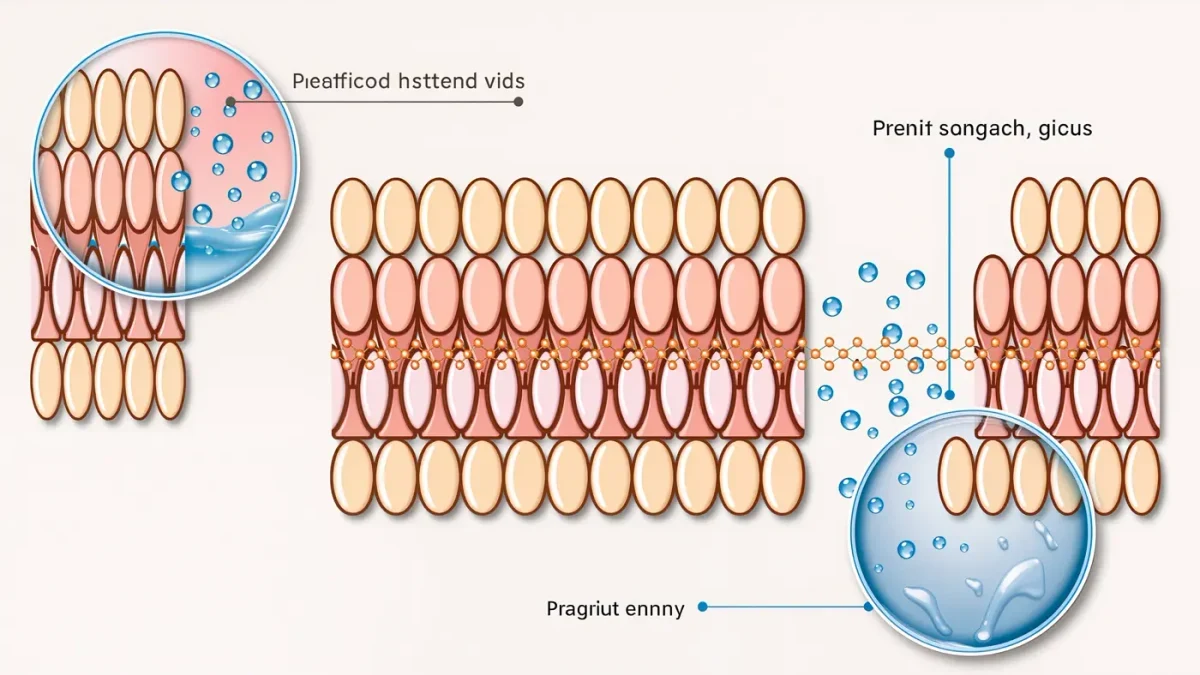
Ceramides are a family of waxy lipid molecules that make up roughly half the lipid content of the outermost skin layer, and their job is to seal the gaps between skin cells so water stays in and irritants stay out, according to dermatology reviews of the skin barrier summarized on NCBI's PubChem database. If you picture the stratum corneum as a brick wall, skin cells are the bricks and the lipid mortar between them is rich in ceramides. When that mortar thins, from over-cleansing, cold weather, age, or conditions like eczema, skin loses water faster and reacts to things it used to ignore. Ceramide creams work by topping the mortar back up, one layer of lipid at a time.
Ceramide products are among the gentlest in skincare, but persistent cracking, itching, or rash deserves a dermatologist's eyes rather than another cream, and a patch test on the inner forearm is a sensible habit with any new product.
What do ceramides actually do?
Three things, all related to the barrier. They slow water loss through the surface, a process dermatologists call transepidermal water loss. They help the barrier stay flexible, so it bends instead of cracking. And they participate in the skin's own signaling, since reviews note that certain ceramide species are involved in the processes that tell skin cells to mature and shed normally. Reviews of barrier chemistry consistently report that people with eczema and chronically dry skin have measurably lower ceramide levels in the outer layer than people whose skin holds moisture well, which is the clearest evidence for why topical replacement matters.
Do ceramide creams really rebuild the barrier?
They support it, and the honest word is support. A well-formulated ceramide moisturizer replaces some of what is missing, reduces water loss, and gives the skin a quieter environment in which to repair itself. Peer-reviewed studies of ceramide-containing moisturizers show reduced transepidermal water loss and improved hydration within days to weeks of regular use. What a cream will not do is regenerate damaged skin overnight or replace prescription treatment for a diagnosed condition like eczema. Think of ceramide products as maintenance and repair materials, not medicine.
Why do ceramides appear with cholesterol and fatty acids?
Because the barrier's mortar is a precise mixture, not a single ingredient. Reviews of the skin's lipid matrix describe it as roughly equimolar parts ceramides, cholesterol, and free fatty acids, in a ratio that formulators try to echo in barrier creams. This is why many moisturizers list all three, sometimes with the label multi-lamellar or barrier complex. A product with only one of the three can still help, but the trio approach is closer to what your skin builds on its own. You do not need to memorize ratios; a short ingredient list naming ceramides plus cholesterol and a fatty acid is a good sign.
| Skin situation | What to reach for | How often |
|---|---|---|
| Healthy skin, prevention | Light ceramide lotion | Daily, morning and night |
| Dryness from weather or actives | Ceramide cream with cholesterol and fatty acids | Twice daily, plus after cleansing |
| Very compromised, tight or flaky skin | Thick ceramide ointment or balm | Two to three times daily |
How do you add ceramides to a routine?
It is the simplest swap in skincare. Replace your usual moisturizer with a ceramide-containing one and use it as you already do, morning and night, on slightly damp skin. The American Academy of Dermatology's moisturizer guidance is built on the same principle: moisturize within a few minutes of washing to trap water. Two habits quietly undo ceramide work, and fixing them matters as much as the cream. First, harsh foaming cleansers and hot water strip lipids faster than any cream replaces them. Second, layering strong actives nightly without rest days keeps the barrier under constant pressure. A ceramide cream alongside gentle cleansing is a complete barrier plan for most people.
Do ceramides suit oily and acne-prone skin?
Yes, in a lighter texture. Oily skin still needs a working barrier, and reviews note that a damaged barrier can worsen acne by letting irritation in. Choose a gel-cream or fluid lotion with ceramides rather than a heavy balm, apply it after cleansing at night, and check that the formula is labeled non-comedogenic if you are prone to clogged pores. Plenty of acne-friendly moisturizers now include ceramides precisely because drying acne treatments strip the barrier.
Are plant-derived ceramides different?
Modestly, and mostly by name. Skincare uses ceramides made by fermentation or synthesis, and phytoceramides from plants, most often in oral supplements. Topical reviews treat synthetic ceramides as the reference standard because their structure matches the skin's own. Oral phytoceramide supplements have some small studies behind them for dryness, but the evidence base is thinner than for creams, and a moisturizer costs less per month. For beginners, the cream is the better-evidenced route.