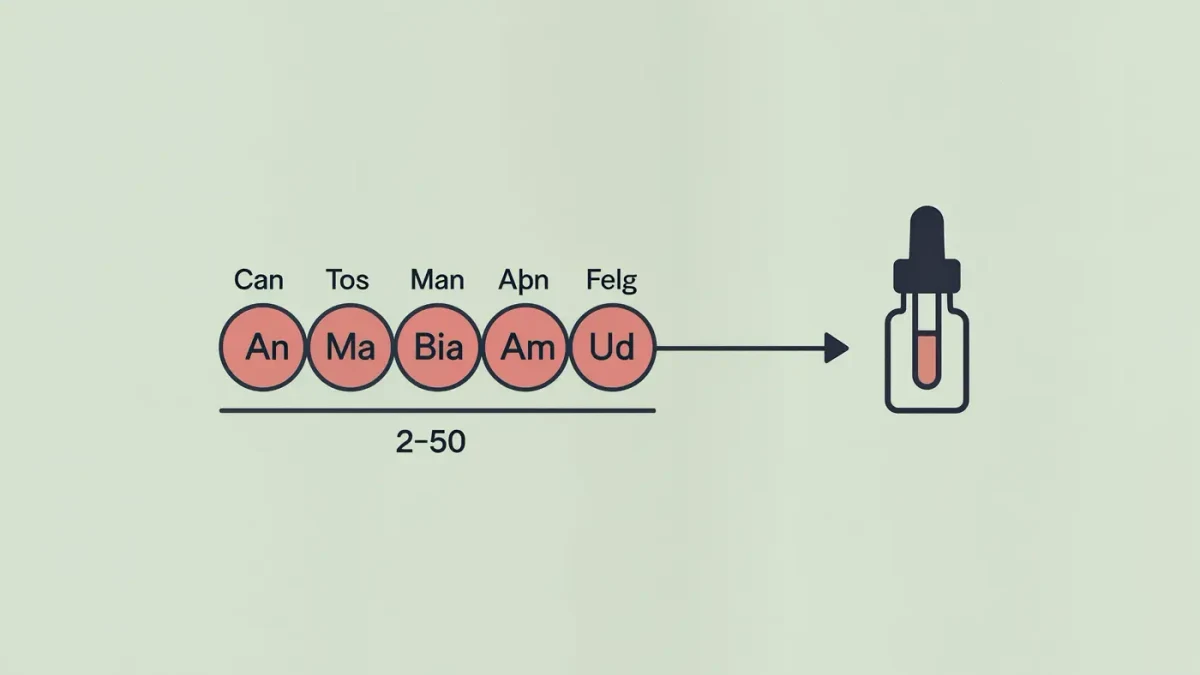
Peptides in skincare are short chains of amino acids, generally between two and fifty links long, that sit on the skin's surface and act as signaling fragments, according to compound summaries on NCBI's PubChem database. In creams they are sold on a plausible idea: fragments of collagen and other proteins tell skin cells that repair work is needed, so applying them topically might nudge the skin to behave as it does during healing. The honest read of the evidence, from peer-reviewed reviews of cosmetic peptides, is modest and narrow: some peptide formulas show small improvements in fine lines and firmness in controlled studies, many commercial claims rest on far weaker data, and no topical peptide rebuilds lost collagen the way a retinoid or an in-office treatment changes skin structure.
BEAUTYISE publishes information, not medical advice. Peptide products are generally well tolerated, but if you have a skin condition or are treating a medical concern, a dermatologist should steer the plan, and a two-day patch test on the inner forearm remains a sensible habit with any new product.
What are peptides, in plain language?
Proteins are long chains of amino acids; peptides are the short versions. Cut a protein into pieces of two to fifty amino acids and you have peptides, which is exactly what happens during the skin's normal repair process, when enzymes chop old collagen into fragments. Reviews of peptide cosmeceuticals describe three families used in skincare. Signal peptides, the largest group, are fragments that in laboratory studies appear to stimulate skin cells to produce more of the material skin is made from. Carrier peptides, such as copper peptide, deliver trace elements to cells. Neurotransmitter peptides are marketed as relaxing expression lines, an idea borrowed from injectables, with the thinnest evidence of the three.
What does the evidence actually support?
Small, real effects on surface texture and firmness, from a handful of ingredients. Reviews of clinical peptide studies report that certain signal peptides and copper tripeptide formulas produced measurable, modest improvements in wrinkle depth and elasticity over eight to twelve weeks in controlled trials. Three limitations run through that literature, and they explain why dermatologists describe peptides as promising rather than proven. First, many studies are small and funded by the ingredient's own manufacturer. Second, testing is done on specific molecules, so results for one peptide do not transfer to a blend of ten. Third, effects are surface-level; peer-reviewed reviews are consistent that nothing topical rivals retinoids for documented collagen effects.
| Peptide family | Claimed action | Strength of evidence |
|---|---|---|
| Signal peptides (e.g., Matrixyl-type) | Nudge collagen production, soften fine lines | Modest; small controlled trials |
| Carrier peptides (copper tripeptide) | Support repair processes, firmness | Modest; some small trials |
| Neurotransmitter peptides (Argireline-type) | Relax expression lines like a mild injectable | Weak; mostly lab and small studies |
Related stories: What Urea Does in Skincare: Humectant at Low Percentages, Keratolytic at High · What Are Alpha Hydroxy Acids? A Beginner's Guide to Glycolic and Lactic.
How do you use a peptide product?
Peptides are among the easiest actives to slot into a routine, because they do not conflict with much.
- Apply after cleansing and water-based serums, about thirty seconds of work. Peptide serums typically go on before heavier creams, in the morning or evening.
- Use it daily and expect eight to twelve weeks. The timelines in the small clinical trials are the realistic benchmark for judging any result.
- Layer it with your moisturizer and sunscreen as usual. There is no known conflict with retinol, vitamin C, or acids, though a very acidic formula can degrade some peptides, which is why products rather than DIY mixing are advised.
- Store reasonably; peptides are delicate molecules. Reviews of peptide stability note they degrade with heat and time, so a closed bottle in a cool cabinet beats a windowsill.
Skip peptide products if your budget is tight and your routine lacks sunscreen or a retinoid; those two have decades of evidence and peptides are a refinement, not a foundation.
Do peptides penetrate the skin at all?
Only a little, and only certain ones. The skin's outer layer is designed to keep large, water-loving molecules out, and peptides are both. Reviews of peptide delivery note that most topicals leave the peptide in the upper layers, and that effects on deeper cells, if real, likely happen through signaling at the surface. Formulators improve uptake with carrier systems and by choosing smaller fragments. The practical takeaway: a peptide sitting near the surface is not useless, because signaling happens there, but it caps what any cream can claim.
Are they worth the money?
As a third or fourth step, for some people, yes; as a headline purchase, usually no. A reasonable test is opportunity cost. Sunscreen, a retinoid, and a ceramide moisturizer have the strongest evidence bases in skincare, and a peptide serum earns a place only once those are habits. If you enjoy the ritual and your skin tolerates it, a single peptide serum used daily for three months is a fair experiment, judged on texture and fine lines in a mirror and daylight, not on marketing language.