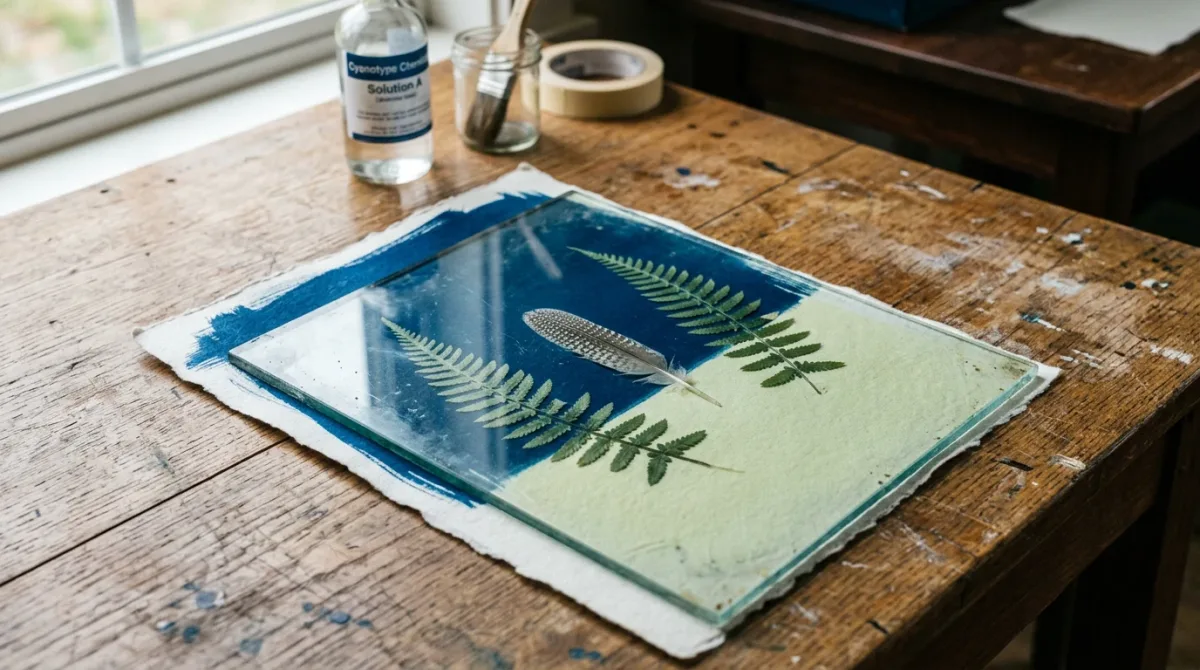
Cyanotype is a camera-less printing process in which two iron salts, brushed onto paper and dried in darkness, react under ultraviolet light to form Prussian blue, a pigment so insoluble and so intensely coloured that the finished print needs nothing but a wash in plain water to fix it. Lay a fern frond on the coated sheet, carry it into the sun, and the paper keeps a pale silhouette in a deep blue field.
The process reached us through an astronomer. Sir John Frederick William Herschel sent the Royal Society a fifty-six-page handwritten paper from Collingwood in Kent, dated 13 June 1842 and titled "On the action of the rays of the solar spectrum on vegetable colours, and on some new photographic processes". The Society's own catalogue records that the manuscript was received on 15 June and read on 16 June 1842, before appearing in Philosophical Transactions on 31 December of the same year.
Herschel was a chemist as well as an astronomer, and the cyanotype came out of a long hunt for colour in photography. The Harry Ransom Center at the University of Texas at Austin notes that he worked through hundreds of variations of chemical formulas, coined the photographic terms "negative" and "positive", and left behind a process the Center calls the originator of the architect's blue-print. The same account records that cyanotypes came into wide use from 1880, helped by the fact that only water is needed to fix the image.
What happens on the paper when the sun reaches it?
Ultraviolet light reduces the iron in the sensitised coating, and the newly formed iron(II) reacts with ferricyanide to build Prussian blue, chemically ferric ferrocyanide. Writing for the American Institute for Conservation's Topics in Photographic Preservation, the chemist Mike Ware describes the resulting pigment as "highly insoluble; most intensely coloured, and most stable of all possible products".
Because the reaction is driven by light rather than by a developer, the paper behaves like a slow, forgiving film. Cornell University Library's survey of non-silver processes describes cyanotype as an iron-based paper positive with Prussian blue as the image material, in use from 1842 to 1920, and notes that it yields shades of blue in proportion to the amount of light received. Thin, translucent material lets a little light through and prints as a mid-blue; a folded stem or a coin blocks it entirely and stays white.
Why did the first photographically illustrated book use it?
Anna Atkins turned to cyanotype because it recorded translucency as tone. Her Photographs of British Algae: Cyanotype Impressions was made between 1843 and 1853 and is, as Aperture puts it, "now widely seen as the first photographically illustrated book". Atkins produced roughly fourteen copies, which Aperture calculates required some six thousand cyanotype photogram exposures on hand-treated paper.
What makes the plates hold their charm nearly two centuries on is exactly what the process does best. Aperture describes the prints as showing not only silhouettes but "gradations of blue showing the thickness of the strands of seaweed", on hand-stitched folios watermarked J. Whatman Turkey Mill. Herschel himself received one of the original copies as a gift.
How is a cyanotype made, step by step?
The sequence is short, and every stage of it is old. The coating is mixed and applied by hand, the exposure is judged by eye, and the wash does the work that a fixing bath does in silver photography.
- Mix and brush the sensitiser. Ferric ammonium citrate and potassium ferricyanide are brushed onto paper, as the Ransom Center describes Herschel's method.
- Dry the sheet in darkness. The coated paper is dried away from daylight, because it begins responding to ultraviolet the moment it meets it.
- Arrange the subject. Pressed leaves, lace, feathers or a negative are laid on the dry coating, usually under glass so the contact stays even.
- Expose to the sun. Density builds in proportion to the light received, so a thicker leaf prints paler and a bare margin goes to full blue.
- Wash in plain water. No fixing chemistry is required, but the wash should be generous rather than quick, for reasons the conservation literature makes plain.
Does the length of the wash really matter?
It matters more than almost anything else in the process. Ware's conservation study compared identically exposed prints and found that one washed for twenty minutes showed a maximum fade of 16, while one washed for only four minutes faded by 42 under the same light. Unprocessed sensitiser left in the paper catalyses fading, so rinsing it out is a preservation decision as much as a finishing step.
That single number is worth carrying to the sink. A print pulled from the water after a minute or two looks finished, and the difference only announces itself years later, on a wall in daylight.
Why do cyanotypes fade, and can the blue come back?
Light reduces Prussian blue to colourless Prussian white, which is why a framed print left in a bright room loses depth. Ware's finding is the cheering part: the fading caused by moderate daylight exposure is completely reversible by air re-oxidation, with density recovering by at least 95 per cent within a day of dark rest and 99 per cent within five days.
The recovery depends on air reaching the paper, which is why conservators favour deep window mounts that leave the print in communication with the atmosphere rather than sealed tight against glass.
How should a finished print be stored?
Alkalinity is the real enemy. Ware records that a 0.25 molar solution of sodium carbonate, at a pH of around 10.7, destroys Prussian blue in less than half a minute, and that even mildly alkaline conditions threaten it, so mildly acidic storage is preferable. Alkaline-buffered board, the default in many archival kits, should not sit in direct contact with a cyanotype.
The practical shopping list follows from the chemistry: unbuffered archival paper for wrapping, mounts that admit air, and a spell in the dark after any long period on display. Ware also cautions that archival polyester is less than ideal as sleeving for cyanotypes, precisely because the print wants to breathe.
Today the process asks for very little — two salts, a brush, a sheet of glass and a bright afternoon — and gives back a blue that has outlasted most of the photographic chemistry invented alongside it. Herschel was chasing colour and found one colour, thoroughly; Atkins spent a decade proving how much a single hue could describe. The sun still does the printing.
For a related business news perspective, read Britain's £90,000 VAT Threshold Draws a Line for Growing Craft Businesses.
For more context, read How night shift work pulls the body's clocks apart.
For more context, read What to Know About Dietary Fiber.
For more context, read Skin cycling is basically a recovery day for your face.