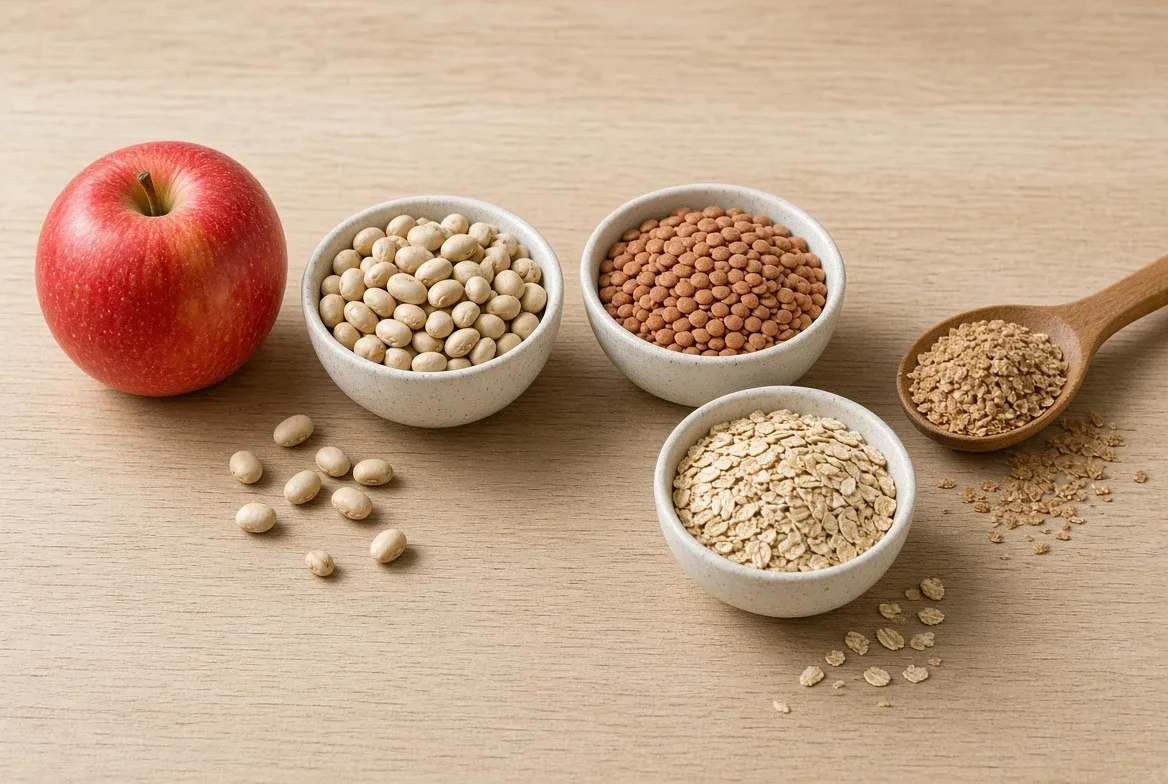
Dietary fiber is the part of plant foods that human digestive enzymes cannot break down. A 2019 series of systematic reviews in The Lancet reported the highest intakes associated with 15% to 30% lower rates of death and several chronic diseases than the lowest, an association rather than proof of cause, strongest near 25 to 29 grams daily.
What is dietary fiber?
Dietary fiber is a group of plant carbohydrates that pass through the small intestine largely intact instead of being digested and absorbed. For food labeling purposes, the US Food and Drug Administration defines dietary fiber as naturally occurring fibers in plants plus certain isolated or synthetic non-digestible carbohydrates that the agency has determined have beneficial physiological effects. That second half of the definition matters on a label: not every non-digestible carbohydrate added to a processed food counts toward the fiber line, only those the agency has accepted.
The clinical literature usually divides fiber by how it behaves in water. A StatPearls clinical review hosted by the National Library of Medicine describes soluble fiber as fiber that dissolves in water and is partially fermented in the colon, and insoluble fiber as fiber that does not dissolve and mainly adds bulk to the stool. Within the soluble group, viscous fibers such as pectins and gums absorb water and form a gel that, according to the same review, slows gastric emptying and delays glucose absorption. Fermentable fibers are broken down by gut bacteria into short-chain fatty acids, which the review describes as having anti-inflammatory effects.
Most fiber-containing foods supply a mixture of these types rather than one in isolation. The FDA's labeling materials list beans, peas, lentils, fruits, nuts, seeds, vegetables, wheat bran, and whole grains such as oats, brown rice, popcorn, and quinoa among the food sources of fiber. In short, fiber is a category of behaviors in the gut, not a single substance.
How much fiber do official bodies say people need?
Different bodies publish different numbers, because they are answering different questions. The Institute of Medicine, now the National Academy of Medicine, set an Adequate Intake rather than a Recommended Dietary Allowance, which signals that the underlying evidence was judged sufficient to estimate a reasonable level but not to establish a requirement. Nutrition Facts labels use a single Daily Value so that one percentage works for every package. Research groups report the intake range at which an association appeared strongest, which is a description of observed data, not a prescription.
| Issuing body | Year | Stated amount |
|---|---|---|
| Institute of Medicine, Adequate Intake, as reported in the National Library of Medicine's StatPearls review | Issue year not stated in the source consulted | 25 g/day for women, 38 g/day for men, or 14 g per 1,000 kcal |
| US Food and Drug Administration, Nutrition Facts label | 2021 label materials | Daily Value of 28 g/day, based on a 2,000-calorie diet |
| Reynolds and colleagues, The Lancet | 2019 | Greatest observed benefit at 25 to 29 g/day |
For children and adolescents, the StatPearls review reports figures ranging from 19 grams daily for young children to 25 to 26 grams a day for older girls and 31 to 38 grams a day for older boys. On packaged foods, the FDA's labeling materials treat 20% or more of the Daily Value per serving as high in fiber and 5% or less as low, which is why two products with similar-looking ingredient lists can carry very different claims. These figures are the issuing bodies' numbers, not this publication's recommendation, and none of them is a target set for any individual reader.
Guidance at the national level is also in motion. The Dietary Guidelines for Americans, issued jointly by the US Departments of Agriculture and Health and Human Services, moved to its tenth edition covering 2025 to 2030, published in January 2026, with an emphasis on whole, nutrient-dense foods including whole grains. Internationally, the World Health Organization published a 2023 guideline on carbohydrate intake for adults and children that frames carbohydrate quality in terms of fiber content and whole grains rather than carbohydrate quantity alone.
What does the evidence say about fiber and long-term health?
The largest single synthesis is the 2019 Lancet series by Reynolds and colleagues, which pooled 185 publications of prospective observational studies representing roughly 135 million person-years, alongside 58 randomized controlled trials involving 4,635 adults. Comparing the highest fiber intakes with the lowest, the observational data were associated with 15% to 30% lower incidence of all-cause mortality, coronary heart disease, type 2 diabetes, and colorectal cancer. The authors translated this into absolute terms as roughly 13 fewer deaths per 1,000 participants and 6 fewer coronary heart disease cases per 1,000. Because the bulk of that signal comes from observational work, it describes what happened in populations who ate differently, and cannot by itself establish that fiber caused the difference.
The same series found broadly similar patterns for whole grains, with risk reductions in the range of 13% to 33% across mortality and disease outcomes, and reported that the findings support replacing refined grains with whole grains. Glycemic index performed considerably worse as a predictor: the series identified an 11% risk reduction for type 2 diabetes that attenuated to about 5% in sensitivity analysis, on evidence the authors rated low to very-low quality.
Proposed mechanisms are described in narrower terms. The StatPearls review attributes modest reductions in LDL cholesterol to soluble fiber binding bile acids, blood glucose stabilization to delayed absorption from viscous gels, and digestive regularity to insoluble fiber reducing intestinal transit time and increasing fecal bulk. Mechanism and outcome are separate questions, and a plausible mechanism does not by itself confirm a population-level benefit.
How much fiber do people in the United States actually eat?
Consistently less than the published intake figures. A federal Dietary Data Brief from the Food Surveys Research Group, brief number 12, published in September 2014 and drawing on What We Eat in America data from the 2009 to 2010 National Health and Nutrition Examination Survey with 9,042 participants, reported a mean intake of 16 grams a day among people aged 2 and older, with 18 grams a day among males and 15 grams among females. More recently, the StatPearls review reports an average of about 17 grams daily among American adults for 2017 to 2020, with roughly 94% falling below Adequate Intake levels.
The same federal brief describes where that fiber comes from. Vegetables and fruits combined accounted for 28% of fiber intake; breads, rolls, and tortillas for 12%; cereals for 8%; and plant-based proteins such as beans, legumes, and nuts for another 8%. White potatoes alone accounted for roughly a third of the vegetable contribution, and apples and bananas led the fruit sources. The FDA's labeling materials describe fiber as a dietary component of public health concern precisely because of this gap. The pattern is stable across surveys: intake sits well below every published figure, and it has done so for years.
What remains uncertain?
More than the headline percentages suggest. The Lancet authors rated most of their own evidence moderate or low rather than high, noted unexplained heterogeneity among the pooled studies, and reported limited data on specific fiber sources beyond cereals. They also noted an absence of epidemiological evidence on highly processed whole grain products, which is a meaningful gap given how much of the grain supply is processed.
Two further questions are not settled by this body of work. The first is whether isolated or supplemental fiber produces the outcomes observed for fiber-rich whole foods; the observational studies measured dietary patterns, not supplements, and the randomized trials in the series were far smaller and shorter than the cohort data. The second is how much of the association reflects fiber itself rather than the other characteristics of people who eat more of it. Observational nutrition research cannot fully separate the two, which is why the Lancet series reports associations and the certainty ratings sit where they do.
When should a person talk to a clinician?
This article is information, not medical advice, and it is not a substitute for evaluation by a qualified clinician. Anyone with new, persistent, or worsening digestive symptoms should be assessed rather than attempt to manage the problem through diet alone. The National Institute of Diabetes and Digestive and Kidney Diseases, in guidance on constipation last reviewed in May 2018, states that a person should seek care right away for bleeding from the rectum, blood in the stool, constant abdominal pain, inability to pass gas, vomiting, fever, lower back pain, or unintentional weight loss. The same guidance advises consulting a doctor when symptoms persist despite self-care or when there is a family history of colorectal cancer.
Tolerance is also a practical consideration worth raising with a clinician or dietitian rather than resolving alone. The StatPearls review notes that rapid increases in intake can cause bloating, gas, cramping, and general gastrointestinal discomfort, particularly with fermentable fibers such as inulin, and describes gradual increases of about 2 to 3 grams every few days alongside adequate fluid as the commonly used clinical approach. People with existing gastrointestinal conditions, those recovering from bowel surgery, and those taking medications whose absorption may be affected have circumstances that published population figures do not address. The general figures in this article describe populations; an individual plan is a clinical conversation.
For a related prevention perspective, read What to Know About Colorectal Cancer Screening.
For more context, read What Does Vitamin D Actually Do?.
For more context, read What the Research Actually Says About Creatine.
For more context, read How night shift work pulls the body's clocks apart.