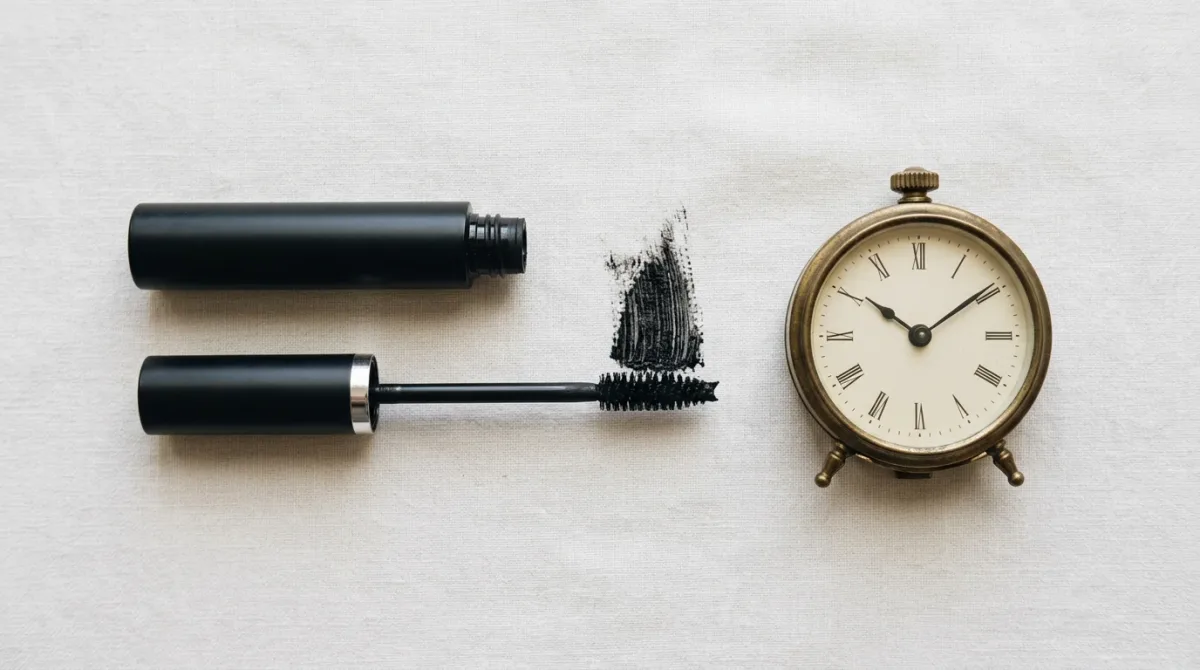
Mascara has the shortest shelf life of anything in a makeup bag: replace it two to four months after you open it, even if the tube still looks and pumps fine. That window comes directly from the U.S. Food and Drug Administration, which warns that eye products carry more infection risk than any other category of makeup, because the wand goes near a mucous membrane every time it's used.
Why does mascara expire so fast?
Every time the wand goes back into the tube, it carries a little bit of whatever was on your lashes: skin oils, air, and bacteria. The FDA's eye cosmetic safety guidance explains that eye cosmetics are especially vulnerable to this cycle because the applicator is repeatedly withdrawn and reinserted, giving microbes a steady supply of moisture and nutrients to grow in. The agency's shelf-life page notes that manufacturers "usually recommend discarding mascara two to four months after purchase," shorter than almost any other product in a routine.
Preservatives in the formula slow that growth down, but they don't stop it, and they weaken with time and exposure to air. WebMD's rundown of makeup disposal timelines makes the same point: eye-area products need more frequent replacement than face products specifically because of how much bacterial and fungal contamination builds up near the eyes with repeated use.
How long can you keep other eye makeup?
Mascara is the fastest to go, but it isn't the only eye product on a clock. The American Academy of Dermatology's guidance on replacing makeup lists eyeshadow and eyeliner at three to six months, while foundation, powder, and blush can last six to twelve months and lipstick or gloss up to twelve to eighteen months. The pattern holds across every source: the closer a product sits to a mucous membrane, and the more often it's dipped into with a wand or brush, the sooner it needs to go.
Some packaging includes a small open-jar icon with a number and an "M" inside it — the Period After Opening symbol. The AAD notes that "the number tells you how many months the product should last after you open it," which is a faster clock than any printed manufacture date, since it starts counting the day air first reaches the formula.
| Product | Typical replacement window |
|---|---|
| Mascara | 2–4 months |
| Eyeshadow, eyeliner | 3–6 months |
| Foundation, powder, blush | 6–12 months |
| Lipstick, lip gloss | 12–18 months |
What are the warning signs it's already gone bad?
Don't wait for a calendar reminder if the product is already telling you it's done. The AAD's guidance flags a short list of signs: the formula clumps or changes texture, it smells different than it did when new, it looks dry, flaky, or runny, or the color has shifted. WebMD adds a simpler test that covers most of these at once: if the product feels different on application than it used to, that's the signal to throw it away rather than try to finish the tube.
A mascara that's gone dry and stringy isn't just annoying to apply. It's also a sign the water content has evaporated and the preservative system has likely broken down along with it, which is exactly the condition that lets bacteria take hold.
Does adding water fix dry mascara?
No, and the FDA is specific about why. Its eye cosmetic safety guidance states plainly: "Don't add saliva or water to moisten it," because water dilutes the preservatives that are keeping bacteria in check, and saliva introduces a fresh source of bacteria from the mouth directly into a product headed for the eye area. A handful of pumps of the wand to try to loosen dried formula does the same thing in miniature, pulling extra air into the tube and speeding up the exact degradation that made the mascara dry in the first place.
If a tube has dried out before its two-to-four-month window is up, the honest fix is a new tube, not a workaround.
Is it safe to use makeup testers or share mascara?
Sharing eye makeup, including in-store testers, is one of the clearest risk factors the FDA calls out. Its guidance is direct: "Don't share your cosmetics. Another person's bacteria may be hazardous to you." If a tester is the only way to try a shade, the agency's advice is to apply it with a fresh, single-use applicator such as a clean cotton swab rather than the shared wand, and never to dip a personal brush or wand into a shared container.
The same logic applies inside one household: a mascara wand isn't something to pass between people even briefly, because each dip reintroduces whatever is already on it.
Common mistakes that shorten mascara's life
- Pumping the wand before application. This pushes air into the tube instead of coating the wand, and air is what speeds up drying and bacterial growth.
- Storing it somewhere warm. The FDA advises keeping cosmetics below 85°F, since heat breaks preservatives down faster and encourages microbial growth.
- Using it through an eye infection. The FDA's guidance is to stop using eye cosmetics at the first sign of irritation and to discard whatever was used before the irritation started, rather than picking the same tube back up once it clears.
- Keeping it "just in case" past the window. A tube that still looks full is not the same as a tube that's still safe; the clock starts at first use, not at empty.
Frequently asked questions
Does mascara really expire if there's no date printed on the tube?
Yes. The FDA notes that U.S. law doesn't require cosmetics to carry expiration dates, but manufacturers still set real shelf-life recommendations, and for mascara that recommendation is two to four months after opening.
What is the Period After Opening symbol?
It's the small open-jar icon with a number and "M" that some packaging carries. The AAD explains the number shows how many months a product is good for once it's opened and exposed to air, which is often the more useful figure than a manufacture date.
Can old mascara actually cause an eye infection?
It can. The AAD cites research finding staph aureus bacteria in mascara after three months of use, and the FDA notes that in rare cases women have been temporarily or permanently blinded by an eye cosmetic infection, which is why the eye-area timelines are stricter than for the rest of a makeup bag.
None of this is a reason to panic over a well-kept, recently opened tube. It's a reason to treat the two-to-four-month window as a real limit rather than a suggestion, skip the water or saliva shortcut, and start fresh the moment a formula changes texture, smell, or color.
For a related skincare perspective, read How to patch test a new skincare product.